Quick Answer
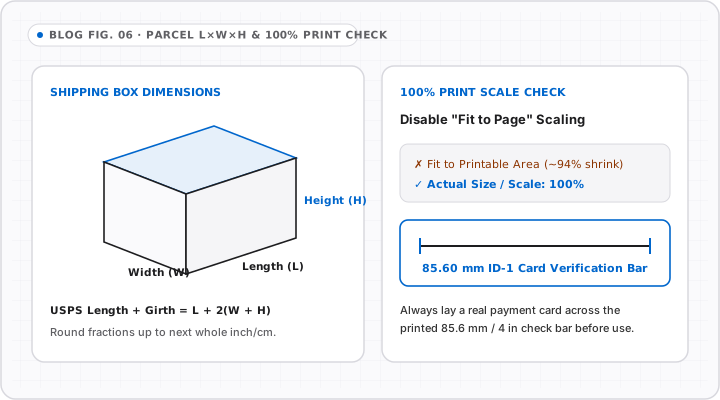
Measure every package by finding its three longest outer dimensions—Length (longest side), Width, and Height/Thickness—rounding fractions up as carriers do, and calculating Length + Girth = L + 2×(W + H) for large parcels. Even 2 mm of envelope bulge can push a Royal Mail or USPS letter into the next price tier.
Postage surcharges rarely happen because someone misread weight—they happen because an envelope bulged past 5 mm or 1/4 inch, or a padded poly mailer pushed a box past Length + Girth cutoffs.
Whether you sell online in the US, UK, Canada, or Australia, here is how carriers actually measure cartons and flat mailers—plus quick ways to verify margins with Photo Ruler or our Online Ruler.
Official Letter & Large-Letter Cutoff Dimensions
| Carrier & Tier | Max Length × Width | Max Thickness | Max Weight | Common Gotcha |
|---|---|---|---|---|
| USPS First-Class Letter | 11.5 × 6.125 in (292 × 156 mm) |
0.25 in (~6.35 mm) |
3.5 oz |
Non-machinable surcharge if rigid or uneven |
| Royal Mail Standard Letter | 24.0 × 16.5 cm (240 × 165 mm) |
0.5 cm (5 mm) |
100 g |
Thick greeting card bows > 5 mm inside |
| Royal Mail Large Letter | 35.3 × 25.0 cm (353 × 250 mm) |
2.5 cm (25 mm) |
750 g |
A4 box mailers often hit 26 mm after tape |
| Canada Post Standard Lettermail | 245 × 156 mm |
5 mm |
50 g |
Anything stiffer than card or >5 mm moves to Oversize |
| Australia Post Small Letter | 240 × 130 mm |
5 mm |
250 g |
Larger than C5/DL bumps immediately to Large Letter |
Tip: Always test the 5 mm / 1/4" thickness limit by laying your sealed envelope flat on a desk and holding our calibrated MM Ruler or Inch Ruler vertically beside the thickest bulge (usually over a clasp, coin, or seam).
How to Measure Carton Dimensions & Length + Girth
- Close and tape the box first: Flattened empty boxes shrink once packed tightly with bubble wrap; always measure the outer stuffed bulge.
- Assign Length (
L): The single longest side (L). - Assign Width (
W) and Height (H): The two perpendicular remaining outer dimensions. - Compute Girth + Combined Size:
Girth = 2 × (W + H)Length + Girth = L + 2W + 2H
- Round conservatively: Carriers commonly round fractional inches up to the next whole inch (or whole centimeter), so never enter
11.9"as11".
Checking Envelope Margins Without a Tape Measure
Need to check an A4 padded envelope or box corner quickly? Lay a standard credit card (85.60 mm) or US Letter (8.5 × 11") / A4 (210 × 297 mm) sheet right next to the sealed parcel, snap an overhead photo, and measure exact outer edges in Photo Ruler. For thickness under 25 mm, verify directly against your calibrated Online Ruler.
Interactive Tools on OnlineRulerPlus
Try It in the Calibrated Workspace
Questions & Answers
Frequently Asked Questions
How do shipping carriers define Length plus Girth?
+
Length is always the single longest side of the box. Girth is the full perimeter wrapped around the two shorter sides: 2 × (Width + Height). Add them together—Length + 2×Width + 2×Height—to check oversized parcel ceilings.
Why did my envelope get charged parcel rate even though its width and height fit?
+
Thickness (and rigidity) catches most shippers off guard. USPS First-Class Letters cap at 1/4 inch (0.25 in / ~6.35 mm), Royal Mail Standard Letters cap at 5 mm, Canada Post Standard Lettermail caps at 5 mm, and Australia Post Small Letters cap at 5 mm. Keys, thick USB drives, or rigid mailers immediately fail letter-slot gauges.
Can I check small envelope margins without owning a tape measure?
+
Yes. Check letter height and thickness with our calibrated screen ruler or photograph larger cartons next to a credit card or A4/Letter sheet inside Photo Ruler—though always leave a 5 mm safety margin before shipping close to any cutoff.
Standards & Verified Sources
- USPS Domestic Mail Manual — First-Class Mail Letters — USPS Letter min 5 × 3.5 × 0.007 in; max 11.5 × 6.125 × 0.25 in (3.5 oz).
- Royal Mail — Size and Weight Guide — UK Letter max 24 × 16.5 × 0.5 cm (100g); Large Letter max 35.3 × 25 × 2.5 cm (750g).
- Canada Post — Lettermail Size Requirements — Canada Post Standard Lettermail max 245 × 156 × 5 mm (50g).
- Australia Post — Domestic Letter Sizing — Australia Post Small Letter max 240 × 130 × 5 mm (250g); Large Letter max 360 × 260 × 20 mm (500g).