Support & Metrology Knowledge Base · 20 Verified Q&As
Frequently Asked Questions
Complete technical answers covering display PPI calibration, ISO/IEC 7810 credit card alignment, metric and 1/16″ fractional inch scales, multi-monitor persistence, and mobile use.
Category 01 · Calibration, PPI & Privacy
Display Calibration, Zoom & Device Compatibility
Is there an online ruler you can use to measure real objects online?
+
Yes. Online Ruler Plus turns any desktop monitor, laptop, tablet, or smartphone screen into a free actual-size online ruler calibrated in inches (with 1/16″ fractions), centimeters, and millimeters. Once you match a standard bank card or enter your display diagonal, tick spacing adjusts to your panel’s physical pixel pitch so you can measure physical objects directly on the glass.
How do you use an online ruler?
+
First, calibrate your display under Calibrate Your Screen using an ISO/IEC 7810 ID-1 payment card (85.60 × 53.98 mm) or your screen diagonal at 100% browser zoom. Second, pick Inches, cm, mm, or px from the workspace toolbar. Third, align the starting edge of your item with the visible 0 mark inside the screen frame (inset from the bezel), then read the opposite edge directly or click the ruler strip to drop draggable measurement guide lines.
How do you read a ruler online in inches, cm, and mm?
+
Start at the 0 datum line, locate the whole unit number just before your object ends, and count the smaller graduation ticks past that number. On the metric scale, numbered centimeters break into ten 1 mm increments with a taller tick at the 5 mm halfway mark. On the imperial inch scale, tick height decreases by fraction: half-inch (1/2″), quarter-inch (1/4″), eighth-inch (1/8″), and sixteenth-inch (1/16″). Moving your pointer across the stage also prints exact coordinates in the top status bar.
How do you identify 1 inch on an online ruler?
+
Switch the workspace to Inches (shortcut 2) after calibrating your display, then look at the calibrated distance from 0 to 1—equivalent to exactly 25.4 millimeters (2.54 cm). Do not count 96 CSS pixels on an uncalibrated monitor, because real screen pixel densities vary widely. For a fast sanity check against calibrated screen ticks, a US Quarter measures 0.955 inches (24.26 mm, just under 1 inch) and a US Penny measures exactly 0.75 inches (3/4 inch).
How do you measure cm and mm online?
+
Click cm (shortcut 1) or mm (shortcut 4) in the workspace toolbar, or launch the dedicated cm Ruler or mm Ruler page. Hold your item flat against the calibrated screen edge starting at the 0 hairline, read whole centimeters along the numbered ticks, and count individual 1 mm divisions to the nearest edge. Turning on Dual cm/in displays both metric and imperial scales simultaneously for side-by-side conversion.
Can I use my phone as a ruler, and can a smartphone measure objects?
+
Yes, within the physical length of your phone display. Modern smartphones pack high-DPI OLED or LCD panels (usually 2x to 3x device pixel ratio), so an uncalibrated 96 PPI web scale renders too small. Open Portrait Card Calibration (53.98 mm short-edge card outline) on your phone first, then place coins, screws, rings, or cards directly on the glass. Items longer than your phone screen—roughly 13 to 16 cm (5 to 6.5 inches)—cannot fit in a single pass and require stepping along a mark or using a physical tape measure.
Can I use my camera as a ruler?
+
Online Ruler Plus does not access your live camera or run AR depth estimation; live ruler measurements happen directly against your calibrated screen glass, and our offline Photo / Ctrl+V tool measures static uploaded or pasted photos from a 2-point reference object. While dedicated mobile apps such as Apple Measure (using LiDAR on supported iPhones/iPads) or Android ARCore rulers estimate room-scale distances through a camera, camera-based estimates are sensitive to lighting, lens distortion, and angle drift.
Why do online rulers require calibration, and does browser zoom break accuracy?
+
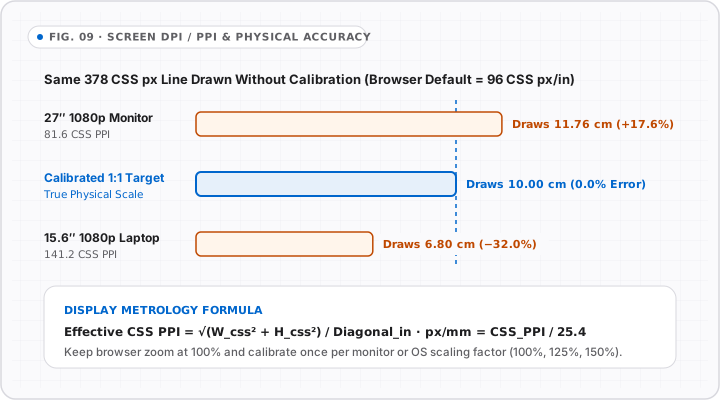
Web browsers render layout dimensions using a fixed W3C reference ratio of 96 CSS pixels per inch while concealing your monitor’s true physical dimensions for privacy. Because physical desktop panels sit around 82 to 110 CSS PPI and laptops often hit 113 to 142 CSS PPI, uncalibrated web rulers routinely err by 10% to 35%. Online Ruler Plus stores your calibrated physical hardware density (devicePxPerMm) in localStorage and listens for devicePixelRatio changes, automatically rescaling tick spacing if you zoom the page.
Does calibration carry across multiple monitors and stay private?
+
Each manual calibration saves locally in browser localStorage keyed by your screen resolution, devicePixelRatio, and platform family. Moving the window to a second monitor with a different size prompts or loads that display’s own saved scale profile. No measurement dimensions, camera streams, or calibration values are uploaded to our servers; cookie and advertising disclosures are detailed on our Privacy Policy page.
Category 02 · Measurement Techniques & Conversions
Unit Conversions, Guide Lines, Overlays & Printing
How many centimeters are in 1 inch and in a 12-inch ruler?
+
Under the 1959 international yard and pound agreement (NIST and BIPM), 1 imperial inch is defined as exactly 2.54 centimeters (25.4 millimeters), and 1 centimeter equals 0.3937008 inches. Multiplying 12 inches by 2.54 cm/in shows that a standard 12-inch (1-foot) ruler equals exactly 30.48 centimeters (304.8 millimeters). Conversely, a standard 30 cm metric ruler equals 11.8110 inches (approximately 11 13/16 inches), which is 4.8 mm shorter than 1 foot. Using Online Ruler Plus, click the Dual cm/in chip in the toolbar to compare both scales simultaneously.
Why is the 0 mark inset 16 pixels from the edge of the ruler workspace?
+
The 0 datum line on Online Ruler Plus is intentionally inset 16 CSS pixels from the top and left borders of the canvas so the zero graduation tick and dashed alignment hairline sit entirely on flat, unobstructed glass. Physical laptop and desktop monitors have a raised plastic or aluminum bezel that shadows the outermost pixel column and prevents rigid objects from lying flat at pixel zero. Aligning your object with the visible 0 datum line inside the workspace eliminates bezel lip interference and corner parallax error.
How do I measure the diameter of a coin, ring, or circular object on screen?
+
Measuring the outer or inner diameter of a circular object such as a coin, ring, washer, or O-ring is most accurate when using two parallel guide lines on Online Ruler Plus. First, place the circular object flat on the gridded measurement stage inside the workspace. Second, click the top horizontal ruler to drop a vertical guide line tangent to the left edge of the circle, then click again to drop a second vertical guide line tangent to the right edge. The bottom readout bar subtracts the two X coordinates (ΔX) and displays the exact diameter in mm, cm, or 1/16″ inches.
Can I measure objects longer than my laptop or phone screen?
+
Maximum single-pass measurement length is bounded by your display panel’s physical width or height—for example, 14.1 cm on a 6.1-inch smartphone, 34.5 cm (13.6 in) on a 15.6-inch laptop, or 59.8 cm (23.5 in) on a 27-inch desktop monitor. First, press F to enter fullscreen mode so the ruler uses 100% of your screen width. Second, if an object exceeds your monitor width, place a small piece of painter’s tape or a pencil mark on the object at a whole graduation (such as 25.0 cm or 10.0 in), shift the mark back to the 0 line, and add the remaining length.
How do I use the 180-degree protractor and floating ruler overlays?
+
Online Ruler Plus includes two interactive stage overlays for non-axial geometry: a draggable Floating Ruler and a 180-degree Angle Protractor. Clicking + Floating Ruler in the workspace toolbar spawns an independent, calibrated ruler bar inside the stage that can be dragged by its body and rotated 360 degrees by its end handle to measure diagonal features. Pressing keyboard shortcut P (or clicking Protractor) opens a semicircular 0° to 180° protractor overlay with a draggable origin vertex and angle ray that reads angles to 0.1° resolution.
How do I print an actual-size ruler at 100% scale without shrinkage?
+
When printing a ruler from your browser (Ctrl+P on Windows/Linux or Cmd+P on macOS) or printing a PDF ruler template, printers default to Fit to Printable Area or Shrink to Fit, which reduces physical scale by 3% to 8%. To guarantee a 1:1 actual-size print in 2026, open More Settings in your print dialog, change Scale from Fit to Page to Actual Size or Custom 100%, and before measuring any part, hold a standard 85.60 mm (3.370 in) ISO/IEC 7810 ID-1 credit card against the printed ruler to confirm that 8.56 cm matches the card width.
What is Optical Parallax Error and how do I avoid it when measuring?
+
Optical parallax error is the apparent displacement of a physical object’s edge relative to the underlying LCD or OLED pixel grid when viewed from an oblique angle through the display’s protective cover glass. Because monitor and smartphone glass typically has a thickness of 0.5 mm to 1.5 mm between the surface and the light-emitting subpixels, viewing from a 30-degree side angle can shift your reading by 0.5 mm to 1.0 mm. Always position your eye directly perpendicular (90 degrees) above the graduation tick mark being read.
How do I use the CSS Pixel (px) ruler mode for web design and QA?
+
Pressing keyboard shortcut 3 (or clicking the px option chip in the unit selector pod) switches Online Ruler Plus into W3C CSS Pixel inspection mode. Unlike physical millimeter, centimeter, and inch modes—which scale according to your display’s calibrated pxPerMm density—CSS Pixel mode measures exact 1:1 logical viewport pixels with minor ticks every 10 px, medium ticks every 50 px, and numbered major ticks every 100 px. Designers and developers use px mode alongside vertical and horizontal guide lines to audit responsive breakpoints and component widths.
How do I reset my saved screen calibration or clear measurement history?
+
All calibration profiles, unit preferences, and saved span records live locally in your browser’s localStorage under the keys orp:calibration:v1, orp:preferences:v1, and orp:history:v1. To reset your active display’s calibration back to the automatic hardware estimate, scroll to the Calibrate Your Screen section and click the Reset Calibration button inside the Active Scale status card. To erase saved span entries, click the Clear button in the Measurement History card on the right side of the calibration section.
How do you view or add a ruler in Word Online?
+
Online Ruler Plus is an independent browser measurement tool, not a Microsoft Office add-in. Inside Microsoft Word for the web (Word Online), switch to Editing mode rather than Reading View, click the View tab on the top ribbon, and select Ruler to show or hide the horizontal document ruler for margins and tab stops. Unlike desktop Word, Word for the web does not display a vertical left margin ruler.
How do you show a ruler in PowerPoint Online?
+
According to Microsoft Support, the traditional desktop layout Ruler (used to measure slide margins) is not available in PowerPoint for the web (PowerPoint Online). Instead, PowerPoint for the web displays automatic red dashed Smart Guides when dragging shapes or text boxes, and provides an ink straightedge under Draw > Ruler for annotations. If you need full desktop measurement rulers and Gridlines/Guides controls, click Editing > Open in Desktop App.
Visual Quick Reference
Instrument Tolerances & Display Scaling at a Glance
Ruler vs Measuring Tape vs Caliper
FIG. 08 · TOOL SELECTION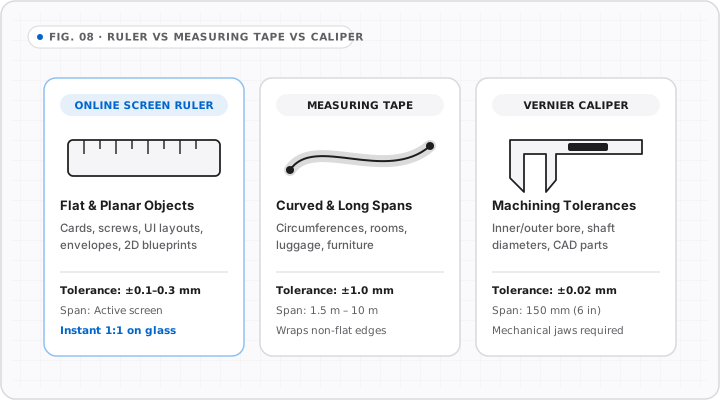
Screen DPI/PPI & Physical Accuracy
FIG. 09 · DISPLAY PHYSICS